HISTORY
At Melling Primary School, History forms an integral part of the curriculum. We believe the study of History inspires children's curiosity, encourages them to ask critical questions and enables them to have a better understanding of the society in which they live and that of the diverse wider world. It helps children gain a sense of their own identity within a social, cultural, political and economic background.
‘A high-quality History education will help pupils gain a coherent knowledge and understanding of Britain’s past and that of the wider world. It should inspire pupils’ curiosity to know more about the past. Teaching should equip pupils to ask perceptive questions, think critically, weigh evidence, sift arguments, and develop perspective and judgement. History helps pupils to understand the complexity of people’s lives, the process of change, the diversity of societies and relationships between different groups, as well as their own identity and the challenges of their time.’ National Curriculum 2014
Aims
In Melling, we follow the Kapow History curriculum which aims to:
- Promote an attitude of curiosity, interest and enjoyment of History
- Develop knowledge of local and national history, and of the wider world
- Develop children’s confidence to think critically, ask questions, and be able to explain and analyse historical evidence
- Build an awareness of significant events and individuals in global, British and local history, and recognise how things have changed over time
- Appreciate the complexity of people’s lives, the diversity of societies and the relationship between different groups
- Appreciate the many reasons why people may behave in the way they do, developing empathy for others
- Build an understanding of chronology and make connections over periods of time
- Understand how historians study the past and construct accounts, and develop the skills to carry out their own historical enquiries
- Introduce the key substantive concepts: power, invasion, settlement and migration, empire, civilisation, religion, trade, achievements of humankind, society and culture
- Enable children to meet the end of Key Stage attainment targets in the National Curriculum
EYFS – Strong Foundations in the Early Years
For children in Reception, the activities allow children to work towards the Understanding of the World Development Matters statements and Early Learning Goals, while covering foundational knowledge that will support them in their further history learning in Key Stage 1.
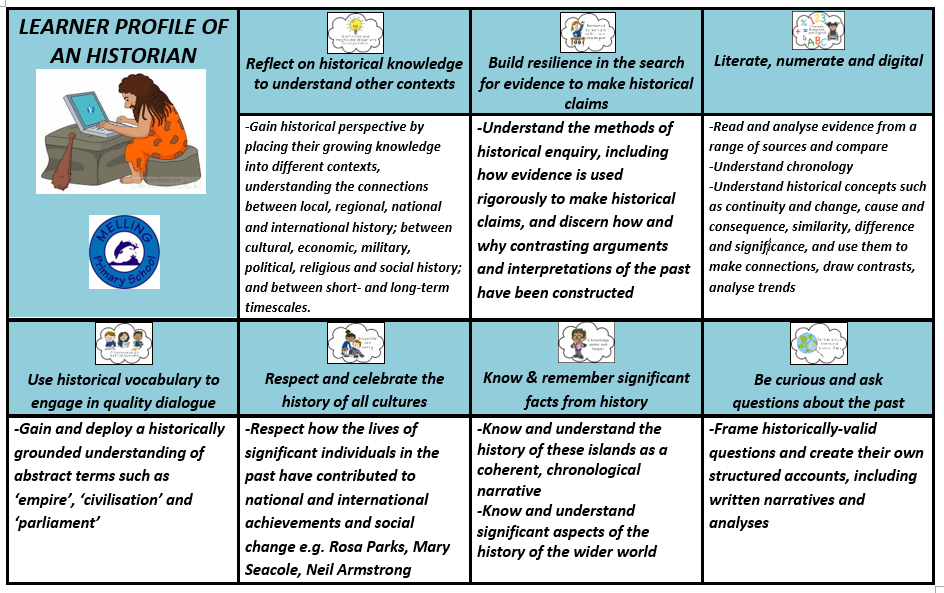
Learner Profile of a Historian
High Quality Teaching Approach
In Melling, History lessons:
- Build and promote an atmosphere in which History lessons provide opportunities for children to explore, discover and interact with the world in which they live and understand how it came to be the way it is
- Use a variety of teaching styles
- Offer first hand experiences
- Use a wide range of resources and historical sources, using primary sources where possible and/or quality secondary sources
- Provide contextual learning; to make sense and draw links to the present day and other periods in History as well as cross-curricular links, although History should remain at the core of the lesson's objectives
- Provide opportunities to gain historical perspective by placing events and periods chronologically on a timeline
- Have a History Mystery/Wow Moment in each lesson
- Use quality provocations at the beginning of topics to provide a hook
- Offer a challenge to all pupils
- Can be outdoors and practical wherever possible
- Offer pupils the opportunities to display/record their results in various ways e.g. timelines, charts, written accounts, letters
- Minimise teacher planned/lead investigation and talk time at a level appropriate to the children’s level of development
- Make learning in History engaging and exciting and provide experiences to live out History
- Enable children to have the opportunity to demonstrate their curiosities: question, analyse, think critically and identify fact, opinion and bias
- Allow children opportunities to plan and carry out their own research
- Provide pupils the opportunity to research and collect data in a variety of ways - secondary data, which may be collected from various sources, may also be used
Progression and Coverage
In order to meet the aims of the National Curriculum and in response to the Ofsted research review into History, Kapow has identified the following key strands, which are interwoven through the units to create interesting and enriching learning experiences allowing children to investigate history as historians do:
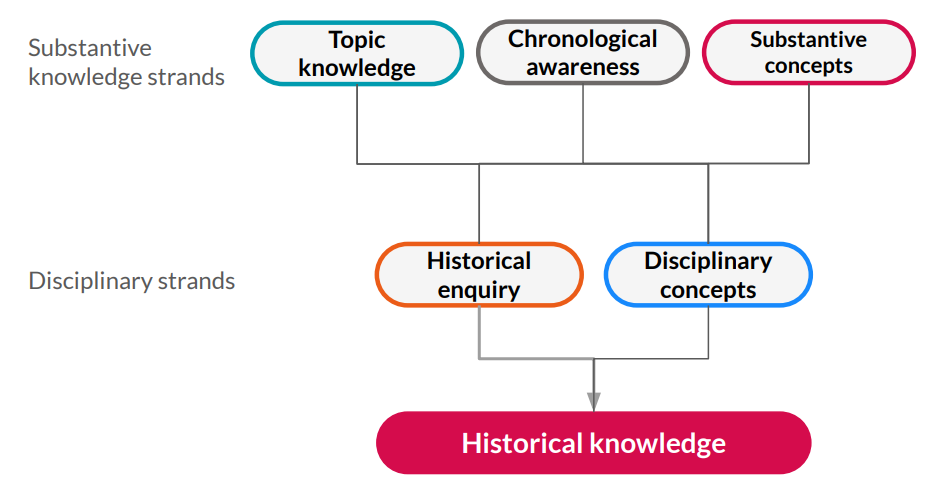
Each 6-lesson unit focuses on chronology. In EYFS, children explore the concept of history by beginning to understand that they have their own histories. Then, they compare and contrast characters from stories, including historical figures, deepening their understanding of how individual lives fit into broader historical narratives. In Key Stage 1, children develop their awareness of the past and will know where people and events fit chronologically. This supports building a ‘mental timeline’ they can refer to throughout their learning in Key Stage 2, identifying connections, contrasts and trends over time.
Over the course of the scheme, children develop an understanding of the following key disciplinary concepts:
- Change and continuity
- Cause and consequence
- Similarities and differences
- Historical significance
- Historical interpretations
- Sources of evidence
Children will have varied opportunities to learn how historians use these skills to analyse the past and make judgements. They will confidently develop and use their own historical skill set. As they progress, they will create their own historical enquiries using sources and the skills they have developed.
Substantive concepts such as power, trade, invasion and settlement are introduced in Key Stage 1, clearly identified in Lower Key Stage 2 and revisited in Upper Key Stage 2. They are returned to in different contexts to enable children to develop an understanding of these themes which are crucial to their future learning in History.
The Kapow scheme follows the spiral curriculum model where previous skills and knowledge are returned to and built upon. Children develop their knowledge and understanding of substantive and disciplinary concepts by experiencing them in a wide range of historical contexts and periods.
SEND & Inclusion - Adaptive Teaching
At Melling Primary, History forms part of a broad and balanced, inclusive curriculum which provides all children with relevant and challenging learning. Through each topic taught, suitable learning challenges are set in response to children’s diverse learning needs. Lessons are designed to be varied, engaging and hands-on. Lessons are designed to be varied, engaging and hands-on.
The Kapow scheme of work is designed to be fully adaptable for children with SEND. Kapow offers guidance on how to adapt the teaching to ensure that lessons can be accessed by all children and opportunities to stretch children’s learning are available. Knowledge organisers support children to build factual knowledge by encouraging recall of key facts and vocabulary.
Children learn in a variety of ways. Therefore, in Melling, we use a range of strategies to support and challenge every child, such as:
Scaffolding – activities are designed with flexibility in mind, allowing for additional support or challenge where needed.
Multi-sensory approaches – lessons incorporate a variety of elements to engage all learners.
Clear instructions and structured tasks – ensuring clarity and reducing cognitive load for children who benefit from additional support.
Opportunities for collaborative and independent learning – allowing children to work at their own pace while building confidence and independence.
By embedding adaptive teaching throughout, we ensure that all children, regardless of their starting points, can access and succeed in their learning.
Children with SEND may have a tailored History curriculum that incorporates some aspects of age-related expectations but will also reinforce vital concepts from previous year groups that have not been fully grasped.
Assessment
Teachers will constantly assess children’s work in History through both formative and summative assessment opportunities. Each lesson includes guidance to support teachers in assessing children against the learning objectives. Each unit has a skills catcher, knowledge catcher and assessment quiz which are used at the end of the unit to provide a summative assessment.
Written or verbal feedback is given to the child to help guide his/her progress. Teachers keep a record of how children are achieving the learning objectives in each unit. This data is used to report achievements to parents at the end of the academic year. Exercise books are taken into the next year group to show progress and development of historical knowledge.
Monitoring
Monitoring and evaluation of practice in History enables the progress of children to be seen within the class and whole-school contexts. This takes place through book looks, Show What You Know sessions (pupil voice) and lesson observations. Findings are used to ensure coverage, continuity and progression in History; and inform action planning, and staff training needs to further enhance teaching and learning in History.
Oracy and the language of History
In Melling, we have identified that our children sometimes struggle with language, and therefore we try to incorporate as many oracy related learning activities into our teaching:
- TOLD - Talk guidelines provide Opportunities to make Links, and initiate Debate.
- Modelling Thinking: Teachers use "think aloud" strategies to model their own reasoning step-by-step, explaining how they reach a certain judgement or conclusion.
- Sentence Stems: Structured sentence starters help children articulate reasoning and build on others' ideas.
- Exploratory Talk: We move beyond simple answers to encourage "talk-rich" classrooms.
- Participation and Routine: Teachers establish talk guidelines and routines from the beginning to ensure all pupils, including those disadvantaged, engage.
Reading and Writing in History
In our History curriculum, reading acts as our time machine, allowing children to engage with diverse texts, sources, vocabulary and narratives that bring past civilisations and historical figures to life. Writing then empowers children to organise these discoveries, moving them from simple recall to structured historical arguments where they can articulate their own judgements about the past. Reading and writing are crucial to history because developing these skills enable children to think, question and communicate like historians.
Equality and Diversity
The Kapow history curriculum is intentionally designed to project a diverse range of voices, ensuring that children encounter history from various cultures, genders, and backgrounds that reflect modern Britain. By exploring both local history and global civilisations, the curriculum fosters a sense of shared belonging while actively challenging stereotypes. This inclusive approach empowers all children to see themselves reflected in the past, nurturing empathy and a deeper understanding of equality.


