PHONICS RWI
Melling approach to Phonics
“Reading was at the heart of the curriculum in the most successful classes. Listening to stories, poems and rhymes fed children’s imagination, enhanced their vocabulary and developed their comprehension. Systematic synthetic phonics played a critical role in teaching children the alphabetic code and, since this knowledge is also essential for spelling, good phonics teaching supported children’s early writing.”
Bold Beginnings Ofsted
Mission Statement
At our school, we believe that every child can learn to read and succeed. Through our commitment to the Read Write Inc. (RWI) approach, developed by Ruth Miskin, we ensure that all children are taught to read with confidence, fluency, and understanding from the very start of their school journey.
We provide a consistent, structured, and engaging phonics programme that enables children to quickly develop the essential skills of reading, writing, and communication. Our dedicated staff deliver high-quality teaching with energy, precision, and care, ensuring that every pupil is supported and challenged to reach their full potential.
Reading is at the heart of our curriculum. By fostering a love of books and language, we empower our pupils to become independent learners, curious thinkers, and confident communicators who are well-prepared for the next stage of their education and for life beyond the classroom.
What is phonics?
All words are made up of individual sounds. These sounds are blended together to form words.
e.g. in ‘mat’ we have the sounds ‘m’, ‘a’, ‘t’, ship – ‘sh’, ‘i’, ‘p’.
A grapheme is another name for the letters we use to write the sound. It’s the spelling of a sound on the page.
Using phonics, children learn to read by saying each sound and blending them to read a word. Children learn to spell by segmenting a word into sounds and writing the matching graphemes.
The National Curriculum ensures that all children are taught Phonics systematically.
Beginning Reading – Intent
At Melling, we recognise that learning to read is fundamental to children’s success across the curriculum and beyond. We understand that secure decoding skills are essential in the early stages of reading, but that decoding alone is not sufficient. Language development and comprehension are equally important in enabling children to become confident, fluent and enthusiastic readers.
Our early reading provision therefore combines systematic synthetic phonics teaching with rich opportunities for storytelling, poetry, discussion and high-quality texts. This balanced approach ensures that children develop both the technical skills required to decode words and the language and comprehension skills needed to understand and enjoy what they read.
Through our early reading curriculum, outlined in this policy and in The Melling Approach to Reading, we aim to ensure that all children:
-
Develop secure phonics knowledge, enabling them to blend phonemes to read words and segment words to support accurate spelling.
-
Understand that blending and segmenting are reversible processes and apply these skills confidently in reading and writing.
-
Recognise and read high-frequency and common exception words.
-
Read texts that closely match their developing phonic knowledge, enabling early success and building confidence.
-
Develop increasing fluency in decoding, allowing them to focus on comprehension.
-
Apply their understanding of phonics, spelling patterns, grammar and punctuation across reading and writing throughout the curriculum.
-
Develop a broad and ambitious vocabulary through regular exposure to stories, poems, rhymes and meaningful discussion.
-
Build their knowledge of the world through language and texts, supporting their understanding of books that they may not yet be able to decode independently.
In line with the findings of Bold Beginnings (Ofsted), we place reading at the heart of our curriculum, ensuring that children are immersed in high-quality texts that nurture imagination, strengthen vocabulary and develop strong comprehension skills alongside effective phonics teaching.
Implementation – Read Write Inc. (RWI)
Systematic Synthetic Phonics: The Key to Early Reading
Phonics provides the essential knowledge and skills required for children to learn to read and spell. Due to the complexity of the English alphabetic code, children must be taught explicitly the relationships between letters and sounds (graphemes and phonemes), alongside the skill of blending individual sounds to read words.
The term ‘synthetic phonics’ refers to the process of synthesising, or combining, sounds in order to read words. In addition, children must learn to segment words into individual sounds in order to spell them accurately. Word reading and spelling are therefore reversible processes: reading involves blending sounds to form a whole word, while spelling requires segmenting a word into its constituent sounds.
A strong evidence base supports the teaching of phonics as the most effective approach for early reading. For example, the Education Endowment Foundation identifies phonics as one of the most secure and well-evidenced areas of educational practice and recommends that schools adopt a systematic approach to phonics instruction.
At Melling, systematic synthetic phonics is taught daily across all infant classes in order to develop and secure:
-
Decoding – reading words through blending sounds
-
Encoding – spelling words through segmenting sounds
Children are introduced to phonics to help them develop the skills needed to access the written code of the English language. They are taught to make clear links between letters and sounds and to apply these skills when reading unfamiliar words. As early writers, children are encouraged to apply their developing phonic knowledge when spelling words, using the sounds they can hear within them.
Home reading books are carefully matched to children’s current phonic knowledge, ensuring that pupils are able to practise and consolidate the skills taught in school.
From the Early Years, children are also taught high-frequency and common exception words. These are words that occur regularly in texts but may not always follow predictable phonetic patterns (for example you, of, he, she). Children are expected to read and spell the words appropriate to their year group.
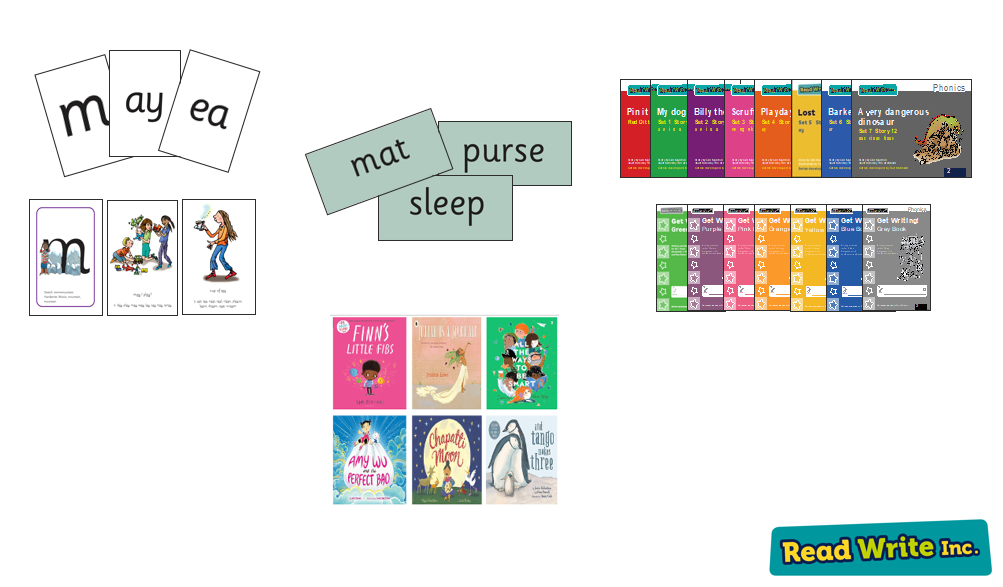
At Melling, the school uses Read Write Inc. Phonics, an inclusive and systematic literacy programme designed to support all children in learning to read. The programme is primarily delivered in Reception, Year 1 and Year 2, and is also used as an intervention in Key Stage 2 where required.
Through the programme, children are taught the 75 sounds of the English language and how to apply these sounds when reading and spelling. The programme places equal emphasis on the development of both reading and writing skills, enabling children to apply their phonics knowledge across the curriculum.
Reading is central to children’s access to the wider curriculum; therefore, secure and efficient decoding is essential. For this reason, Read Write Inc. sessions take place daily, and the structure, pace and consistency of the programme are maintained in order to accelerate pupils’ progress in reading.
Fidelity to the Read Write Inc. Programme
At Melling, the teaching of early reading follows the Read Write Inc. Phonics programme with fidelity and consistency across the school. This ensures that all children receive a structured, systematic and cumulative approach to learning to read.
Staff are trained to deliver the programme effectively and lessons are taught using the agreed routines, resources and progression outlined within the scheme. This consistent approach ensures that children develop secure phonic knowledge and the ability to apply this knowledge fluently when reading and writing.
Children are assessed regularly and grouped according to their current phonic knowledge. These groups are reviewed frequently so that teaching is closely matched to pupils’ needs and progress. This enables all children to move through the programme at an appropriate pace and ensures that those who require additional support receive timely intervention to keep up rather than catch up.
In line with guidance from the Department for Education Reading Framework, reading books are closely matched to pupils’ phonic knowledge so that children practise and consolidate the sounds and words they have already been taught. This allows pupils to read with increasing accuracy, fluency and confidence, building motivation and a positive reading identity.
The pace and structure of daily phonics lessons are carefully maintained to ensure that children revisit prior learning, practise new sounds and apply their knowledge through reading and writing activities. Where children require additional support, targeted intervention sessions are provided to secure their understanding and ensure they remain on track with the programme.
Through consistent implementation of the Read Write Inc. approach, we ensure that all pupils develop the foundational skills required to become fluent, confident readers, enabling them to access the wider curriculum and develop a lifelong love of reading.
Reading for Pleasure and Language Development
At Melling, we recognise that developing a love of reading is central to children’s success as readers. Alongside the systematic teaching of phonics, pupils are immersed in a rich reading environment where high-quality texts are shared regularly.
Teachers read aloud to pupils daily, exposing them to a wide range of stories, poetry, rhymes and non-fiction texts. These shared reading experiences provide opportunities for children to hear fluent and expressive reading, develop their vocabulary, and deepen their understanding of language and storytelling.
Regular opportunities for discussion and book talk enable pupils to explore new vocabulary, express their ideas and make connections between texts and their own experiences. These interactions support children’s oral language development, which is fundamental to later reading comprehension.
Classrooms and shared spaces promote reading through well-stocked book areas and carefully selected texts that reflect a broad range of authors, genres and cultures. Pupils are encouraged to explore books independently and to view reading as an enjoyable and meaningful activity.
Through these approaches, the school aims to nurture confident, motivated readers who develop a lifelong enjoyment of reading.
Assessment and Monitoring of Early Reading
At Melling, the progress of pupils’ early reading development is carefully assessed and monitored to ensure that all children receive the support they need to become confident readers.
Within the Read Write Inc. Phonics approach, pupils are assessed regularly to identify their current phonic knowledge and reading ability. These assessments inform grouping arrangements and teaching priorities, ensuring that instruction is closely matched to pupils’ needs.
Pupils who require additional support are identified quickly and provided with targeted intervention to help them keep pace with the programme. The aim is to ensure that children keep up rather than fall behind in their reading development.
The school also prepares pupils for the Phonics Screening Check, which takes place at the end of Year 1. Outcomes from this assessment are used to identify pupils who may require further support, with additional provision provided in Year 2 where necessary.
Leaders regularly monitor the quality of phonics and early reading provision through lesson observations, learning walks, pupil voice and the review of assessment information. This ensures that teaching remains consistent, effective and aligned with the school’s agreed approach to early reading.
Through ongoing assessment and careful monitoring, we ensure that all pupils are supported to develop the fluency, accuracy and comprehension skills required for successful reading.
Impact
The impact of our early reading provision is that pupils develop the knowledge, skills and confidence required to become fluent and enthusiastic readers. Through the consistent implementation of Read Write Inc. Phonics, children develop secure phonics knowledge which enables them to decode unfamiliar words accurately and with increasing automaticity.
As pupils progress through the programme, they demonstrate increasing fluency, accuracy and confidence in their reading. This allows them to focus more fully on understanding and responding to what they read, supporting strong reading comprehension.
Regular assessment ensures that pupils’ progress is closely monitored and that any gaps in learning are quickly identified and addressed. Pupils who require additional support receive targeted intervention so that they are able to keep up with the pace of learning and achieve success in reading.
Outcomes from internal assessments and the Phonics Screening Check demonstrate that the majority of pupils develop secure early reading skills and are well prepared for the next stage of their education.
Alongside strong decoding skills, pupils develop a rich vocabulary, a secure understanding of language and a positive attitude towards reading. Through regular exposure to high-quality texts and opportunities to discuss and explore books, children develop a genuine enjoyment of reading and recognise its importance as a key skill for lifelong learning.
Ultimately, our approach ensures that pupils leave the early stages of reading as confident, capable readers who are able to access the full curriculum and continue to develop as independent readers.
Reading Culture at Melling
At Melling, we foster a positive reading culture across the school, ensuring that reading is valued as a key skill and enjoyable activity for all pupils. Classrooms and communal areas are equipped with high-quality, accessible texts that reflect a wide range of genres, authors and cultures.
Pupils are encouraged to explore books independently, participate in storytime, book discussions, and poetry sessions, and engage in whole-school reading initiatives such as themed book weeks and author visits. Older pupils support younger readers through reading buddy schemes and peer reading opportunities, promoting confidence and enjoyment.
Through these approaches, children develop not only fluency and comprehension skills, but also a lifelong love of reading, seeing it as both rewarding and meaningful. This culture underpins the school’s commitment to ensuring all pupils leave the early stages of reading as confident, motivated readers ready to access the wider curriculum.