GEOGRAPHY
‘A high-quality Geography education should inspire in pupils a curiosity and fascination about the world and its people that will remain with them for the rest of their lives. Teaching should equip pupils with knowledge about diverse places, people, resources and natural and human environments, together with a deep understanding of the Earth’s key physical and human processes. As pupils progress, their growing knowledge about the world should help them to deepen their understanding of the interaction between physical and human processes, and of the formation and use of landscapes and environments. Geographical knowledge, understanding and skills provide the frameworks and approaches that explain how the Earth’s features at different scales are shaped, interconnected and change over time.’
National Curriculum 2014
AIMS:
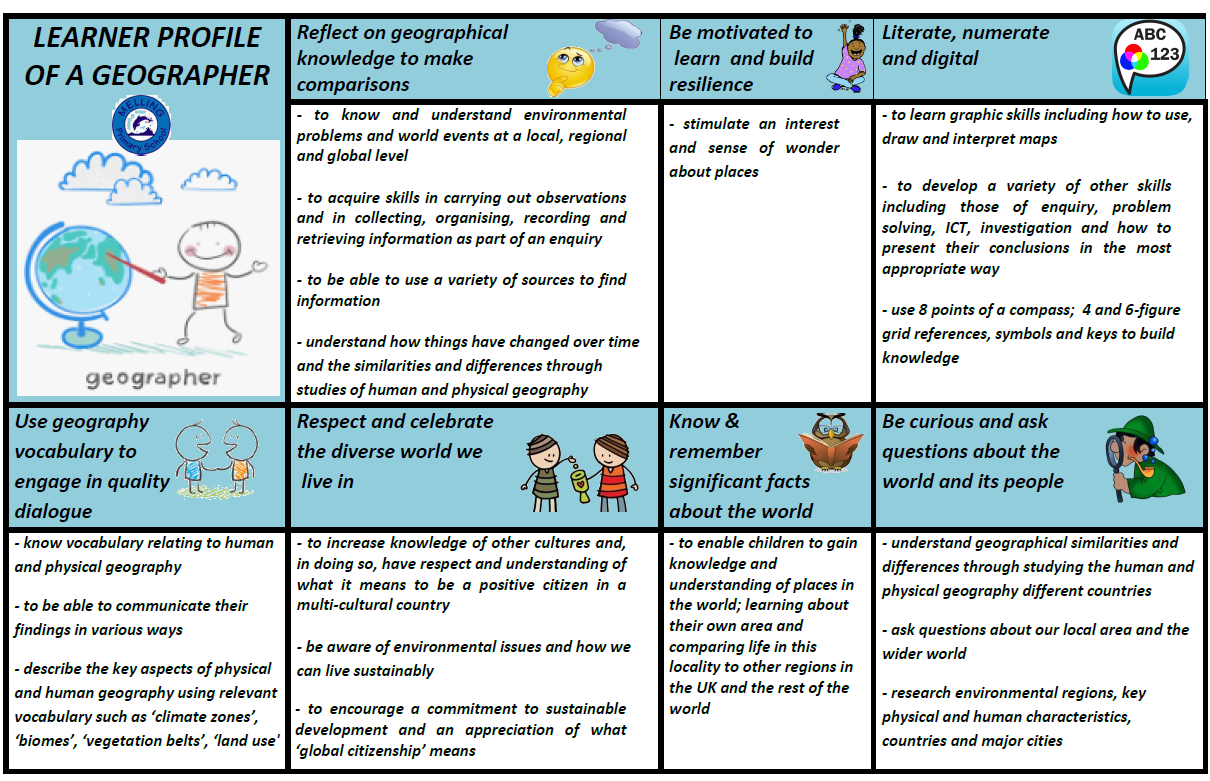
- To enable children to gain knowledge and understanding of places in the world; learning about their own area and comparing life in this locality to other regions in the UK and the rest of the world.
- To increase children’s knowledge of other cultures and, in doing so, teach a respect and understanding of what it means to be a positive citizen in a multi-cultural country;
- To allow children to learn graphic skills including how to use, draw and interpret maps;
- To enable children to know and understand environmental problems and world events at a local, regional and global level;
- To encourage in children a commitment to sustainable development and an appreciation of what ‘global citizenship’ means;
- To develop a variety of other skills including those of enquiry, problem solving, ICT, investigation and how to present their conclusions in the most appropriate way;
- To acquire skills in carrying out observations and in collecting, organising, recording and retrieving information as part of an enquiry. To be able to use a variety of sources to find information. To be able to communicate their findings in various ways.
OUR HIGH-QUALITY TEACHING APPROACH:
- Ensure that pupils are able to make use of their prior learning in moving their geographical understanding forward; as a result lessons are stimulating and often innovative with geographical rigour at their core.
- Is planned with assessment criteria in mind.
- Builds and promotes an atmosphere in which Geography lessons provide opportunities for children to explore, discover and interact with the world in which they live and understand how it came to be the way it is.
- Uses a variety of strategies which cater for pupils who learn in different ways.
- Involve practical activities and field work wherever possible.
- Teachers takes note of any relevant research on children’s misconceptions which may influence their teaching.
- Has a Geography Wow Moment in each lesson
- Gives pupils the opportunity to demonstrate their curiosities: question, analyse, and think critically.
- Offers pupils the opportunities to display/record their results in various ways e.g. maps, charts, written accounts, letters.
- Allows children opportunities to plan and carry out their own research.
- Links to other subjects where they overlap naturally.
- Makes links at a range of scales from the local to the global.
- Uses quality and up to date resources.
SCHEME USED:
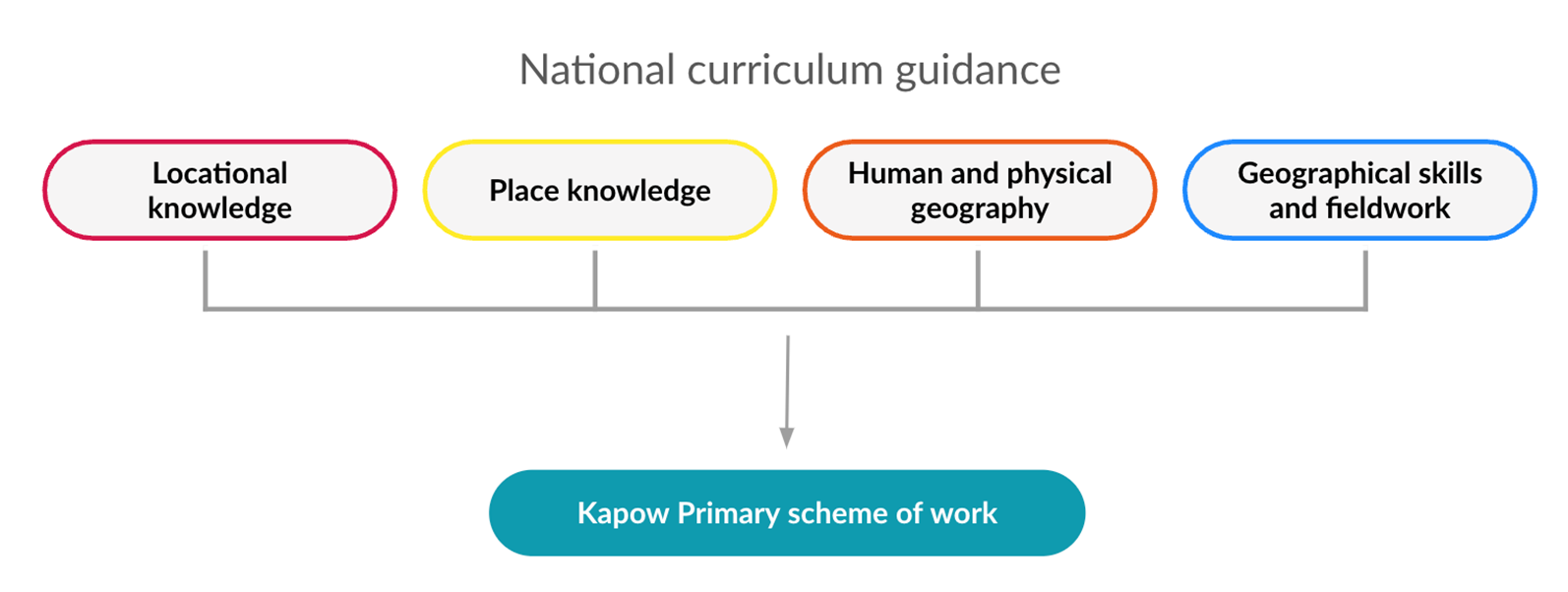
In Melling Primary School, we teach Geography, from Reception to Y6, using the KAPOW scheme of work. Kapow Primary’s Geography scheme of work is built around the following four key areas:
- Locational knowledge – naming and locating places and features from memory; using atlases, globes and maps.
- Place knowledge – developing a sense of the children’s place in the world; comparing and contrasting geographical areas to understand their characteristics and cultures; learning how places are interconnected and change over time.
- Human and physical geography – understanding the relationship between humans and the environment; exploring the Earth’s natural features and processes; considering the impact of human activity on settlements; learning about land use, trade and natural resources.
- Geography skills and fieldwork – using maps and diagrams; describing location and direction; planning and carrying out fieldwork enquiries.
Kapow Primary’s Geography scheme of work aims to inspire pupils to become curious and explorative thinkers with a diverse knowledge of the world – in other words, to think like geographers. The intention is for pupils to develop the confidence to question and observe places, measure and record necessary data in a variety of ways and analyse and present their findings.
The scheme aims to build an awareness of how Geography shapes lives at multiple scales and over time. The hope is to encourage pupils to become resourceful, active citizens who will have the skills to contribute to and improve the world around them.
The scheme supports teachers in developing their subject knowledge and skills, enabling the delivery of engaging, well-informed lessons with confidence. The curriculum is designed to be both accessible and ambitious, ensuring all learners’ full participation and potential achievement.
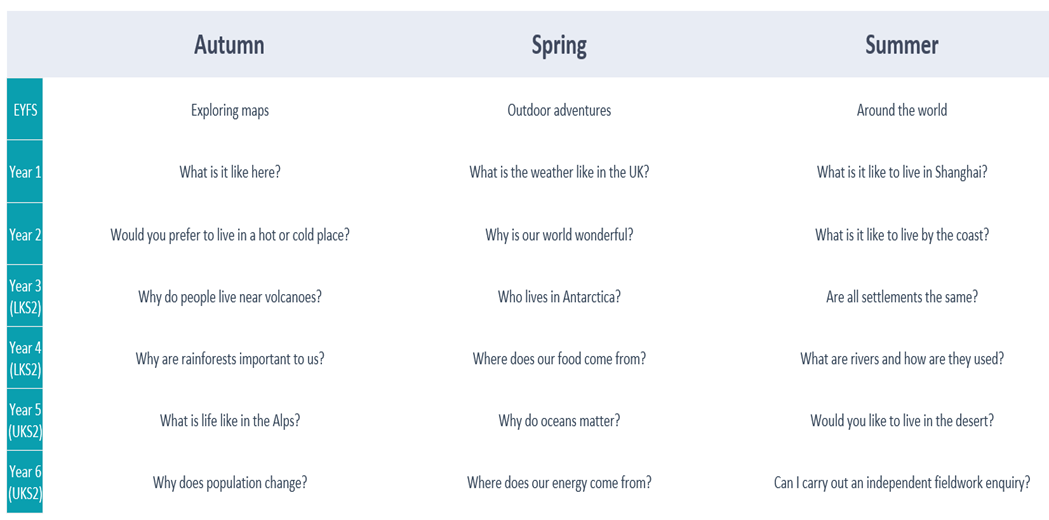
WHOLE SCHOOL COVERAGE:
LEARNER PROFILE:
PROGRESSION OF SKILLS AND KNOWLEDGE:
THE MELLING APPROACH POLICY:
ASSESSMENT:
Kapow Primary Geography lessons include ongoing assessment opportunities, such as questioning, retrieval practice and interactive activities. These enable teachers to assess understanding in real time and adapt their teaching accordingly.
Teachers will assess children’s geography by making informal judgements during lessons through questioning, pupil discussions, pupils work or asking pupils to summarise what they have learnt by writing a sentence at the end of the lesson. On completion of a piece of work, the teacher will assess it against age-related learning objectives, and then use this assessment to plan for future learning. Written or verbal feedback is given to the child to help guide his/her progress. Older children are encouraged to make judgements about how they can improve their own work. For all KAPOW topics, end of unit assessments are available for pupils to see what they can recall and allow teachers to assess the knowledge gained. A record of how children are achieving the learning objectives is kept in the front of their exercise books. This data is used to report achievements to parents at the end of the academic year.
Achievement 2024-25:
|
*Achievement reported in the year 24/25 as follows: Percentage of children at expected or above: YR: 84% Y1:89% Y2: 93% Y3: 90% Y4: 70% Y5: 90% Y6:90% |
Equality and Diversity:
Kapow Primary’s Geography scheme has been designed to represent a range of cultures and races.
- Where appropriate, colonial choices and their impact on geographical issues are explored.
- The scheme’s visual representation is inclusive and representative of a variety of people and places, challenging stereotypes or historical ideologies.
- Within sensitive units, questions have been included to support children’s lived experiences and backgrounds.
- Resources and case studies are carefully considered to encourage the children to think about their role in society and to respect the many ways in which people’s lives have been influenced.
The scheme supports children in appreciating the complexity of people’s lives, the diversity of societies and the relationships between different groups.
SEND AND INCLUSION:
The Kapow Primary Geography scheme of work is designed to be fully adaptable for pupils with SEND. Every lesson includes an adaptive teaching section, providing clear guidance on how activities can be modified to meet the needs of all learners.
Children learn in a variety of ways. As such, Kapow Primary geography lessons include a range of strategies to support and challenge every pupil, such as:
Scaffolding – activities are designed with flexibility in mind, allowing for additional support or challenge where needed.
Multi-sensory approaches – lessons incorporate different elements to engage all learners.
Clear instructions and structured tasks – ensuring clarity and reducing cognitive load for pupils who benefit from additional support.
Opportunities for collaborative and independent learning – allowing pupils to work at their own pace while building confidence and independence.
By embedding adaptive teaching throughout, the scheme ensures that all pupils, regardless of their starting points, can access and succeed in their learning.
In addition, the step-by-step curriculum design supports pupils with SEND, avoiding sudden jumps in complexity at transition points and allowing for steady, manageable progression.
USEFUL WEBSITES:
https://www.natgeokids.com/uk/category/discover/geography/
https://www.bbc.co.uk/bitesize/subjects/zbkw2hv
https://www.kids-world-travel-guide.com/geography-for-kids.html
https://www.natgeokids.com/uk/